
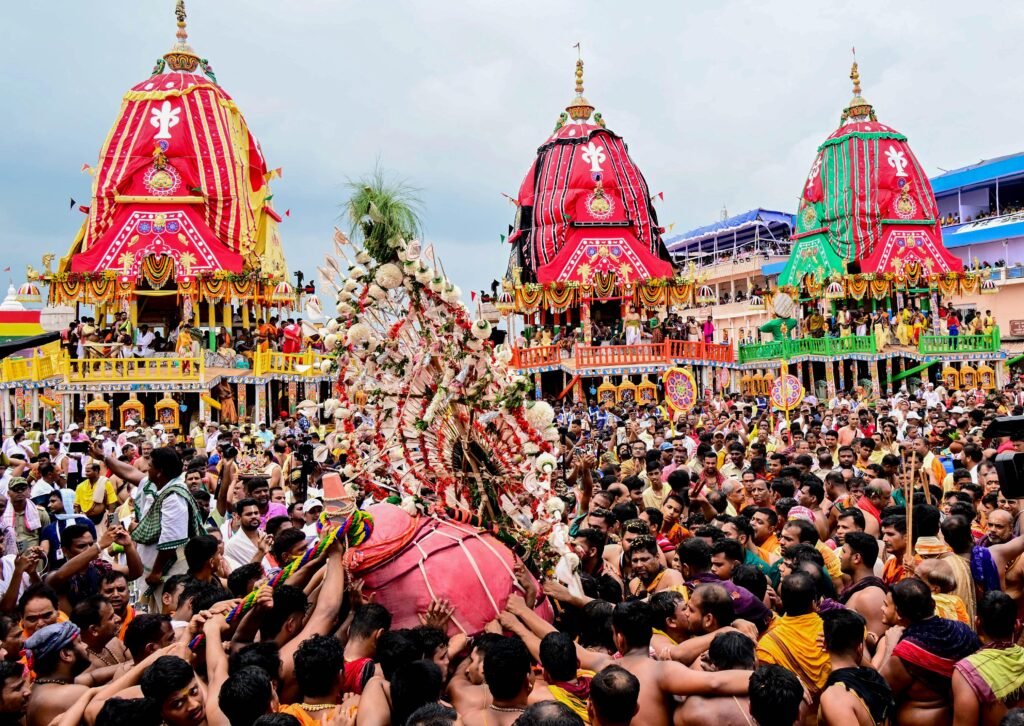
The annual Rath Yatra is the temple’s biggest celebration. During this grand festival, Lord Jagannath, Lord Balabhadra, and Goddess Subhadra are taken out of the temple in magnificent wooden chariots pulled by millions of devotees.
This event attracts visitors from around the globe and is considered one of the largest religious festivals in the world.
What is Rath Yatra?
Rath Yatra, meaning “Festival of Chariots,” is an annual procession during which the deities of Jagannath Temple are taken out of the temple and placed on massive wooden chariots. These chariots are pulled by thousands of devotees through the streets of Puri to the Gundicha Temple.
Unlike most Hindu temples where deities remain inside the sanctum, Rath Yatra allows everyone, regardless of social background, to have the opportunity to see and seek blessings from Lord Jagannath.
History of Rath Yatra
The origins of Rath Yatra date back thousands of years and are deeply rooted in Hindu mythology. According to tradition, Lord Jagannath visits the Gundicha Temple, believed to be the home of his aunt, once every year along with his brother Balabhadra and sister Subhadra.
Historical records indicate that the festival has been celebrated for centuries and gained prominence during the reign of the Eastern Ganga dynasty in Odisha.
Today, Rath Yatra continues to symbolize devotion, equality, and the bond between the divine and devotees.
Rath Yatra Festival: History, Significance, Rituals & Complete Visitor Guide
The Rath Yatra is one of the world’s largest and most celebrated Hindu festivals. Held annually in Puri, this grand chariot festival attracts millions of devotees, pilgrims, and tourists from across the globe. Dedicated to Lord Jagannath, along with his siblings Lord Balabhadra and Goddess Subhadra, the festival is a vibrant celebration of faith, devotion, and cultural heritage.
If you’re planning to witness this spectacular event or simply want to learn more about its traditions, this guide covers everything you need to know about the Rath Yatra Festival.
Spiritual Significance
The Rath Yatra Festival carries profound spiritual meaning.
Symbol of Equality
Lord Jagannath leaves the temple to bless all devotees, including those who cannot enter the temple, symbolizing universal accessibility and compassion.
Journey of the Soul
The procession represents the spiritual journey of every individual toward self-realization and divine connection.
Victory of Goodness
The festival reminds devotees of righteousness, humility, and the importance of faith in everyday life.
The Three Divine Chariots
The Three Divine Chariots
Major Rituals of Rath Yatra
1. Snana Purnima
The deities are ceremonially bathed with 108 pots of sacred water.
2. Anavasara
After the sacred bath, the deities are believed to fall ill and remain away from public view for about 15 days.
3. Netrotsava
This ritual symbolizes the reopening of the eyes of the deities before the grand procession.
4. Pahandi Bije
The deities are carried from the Jagannath Temple to their respective chariots amidst devotional singing and chanting.
5. Chhera Pahanra
A unique tradition where the Gajapati King of Puri sweeps the chariots with a golden broom, demonstrating that everyone is equal before the Lord.
6. Chariot Procession
Thousands of devotees pull the giant chariots from Jagannath Temple to Gundicha Temple over a distance of about 3 kilometers.
7. Bahuda Yatra
After staying at Gundicha Temple for several days, the deities return to Jagannath Temple in the return journey known as Bahuda Yatra.
8. Suna Besha
The deities are adorned with exquisite gold ornaments, attracting huge crowds.
9. Niladri Bije
The festival concludes as the deities ceremonially re-enter Jagannath Temple.
Why Devotees Pull the Chariots
It is believed that pulling the sacred chariots brings spiritual blessings and helps devotees progress toward liberation (moksha). Millions participate with immense devotion, considering it a once-in-a-lifetime opportunity.
Best Time to Visit Rath Yatra
The festival is celebrated every year during the Hindu month of Ashadha, which usually falls in June or July.
The exact dates change annually according to the Hindu lunar calendar.
What Makes Rath Yatra Unique?
Unlike many religious festivals, Rath Yatra allows devotees to physically participate by pulling the giant chariots. The festival is also remarkable because the deities leave the temple, symbolizing their willingness to meet devotees wherever they are.
The combination of devotion, music, rituals, colorful decorations, and community participation creates a deeply moving experience.